Elastic waves in bearing raceways: the forward and inverse problem
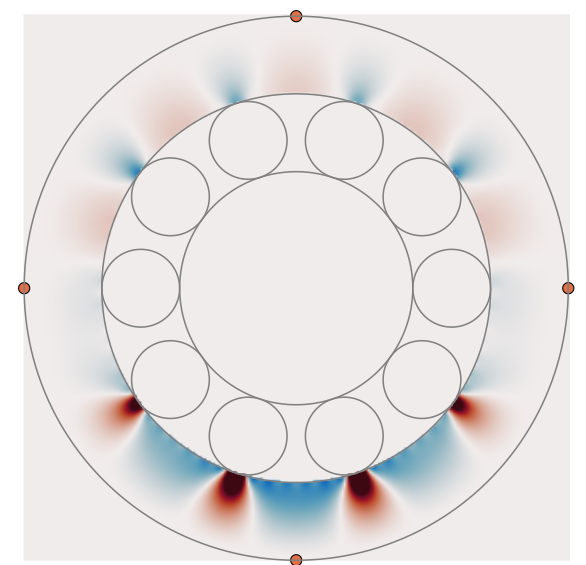
Turbines are crucial to our energy infrastructure, and ensuring their bearings function with minimal friction while often supporting heavy loads is vital. Vibrations within a bearing can signal the presence of defects, friction or misalignment. However, current detection methods are neither robust nor easy to automate. We propose a more quantitative approach by modelling the elastic waves within bearing raceways. By approximating the raceway as a hollow cylinder, we derive straightforward 4 × 4 systems for its vibrational modes, enabling both forward and inverse problem-solving. We also demonstrate how to significantly reduce the number of required sensors by using a simple prior: the known number of rollers and their angular speed. We present numerical examples showcasing the full recovery of contact traction between bearings and the raceway, as well as the detection of elastic emissions.